
Tests as Theorems
Write properties. Prove them for all inputs.
Write a property of C code as an executable spec: a small C program that gcc compiles and runs, with QuickProof supplying the arbitrary inputs. AI agents prove that it holds for every input the program allows, and Rocq (formerly Coq) checks the proof.
A proof is only as good as its spec: it shows that the code does exactly what the spec checks, for the inputs the spec allows, and nothing more. The specs are what you read and review (what you review, and what you trust).
How it works
You have a library under test. QuickProof sits next to it and lets you write tests that state properties of the code. We call such a test a spec: it still runs on any input, and it can also be proved in Rocq, for every input.
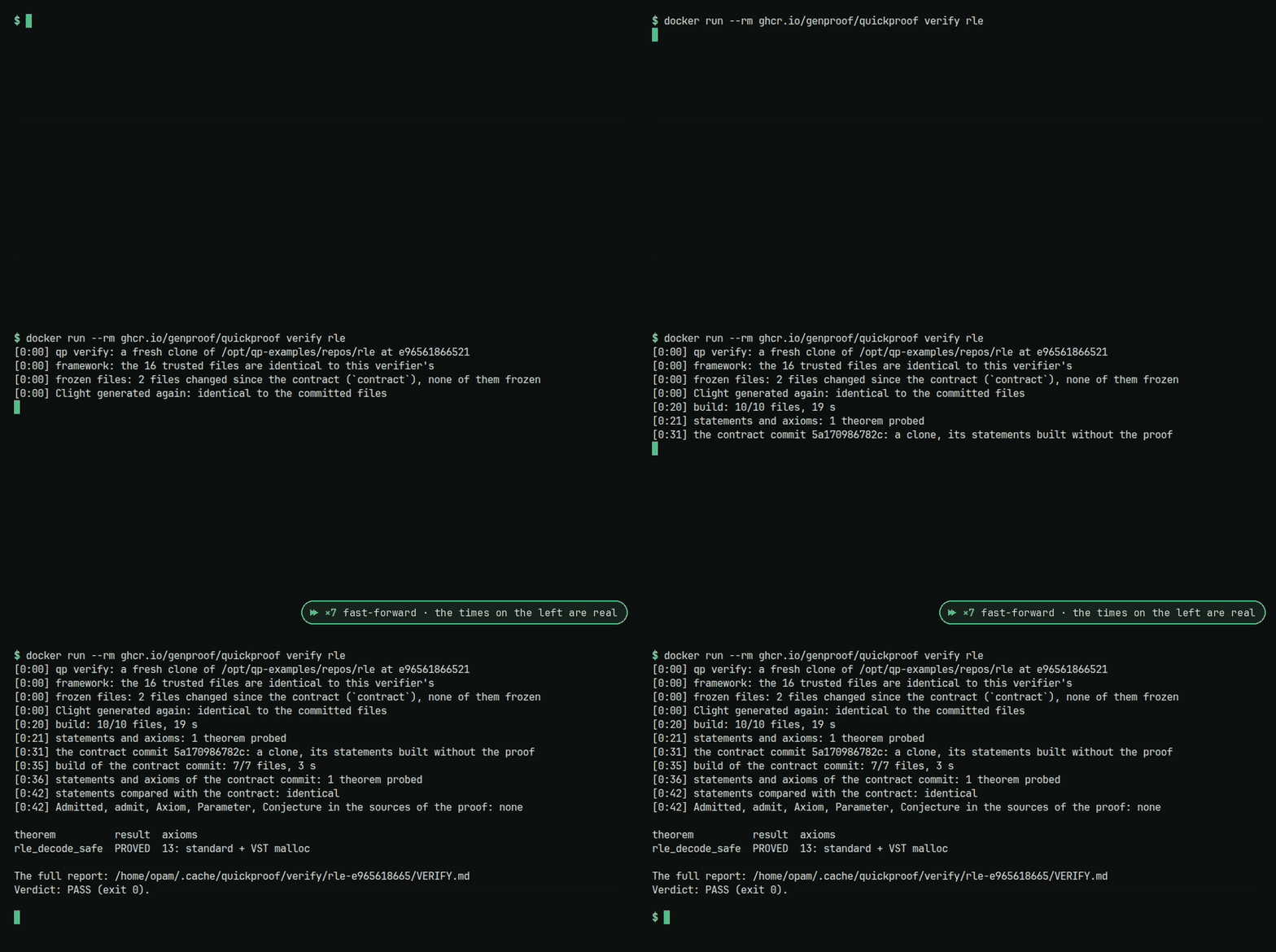
The report as text
$ tools/qp examples rle
[0:00] qp verify: a fresh clone of the proof repository
[0:01] Clight generated again: identical to the committed files
[0:21] build: 10/10 files, 20 s
[0:43] statements compared with the contract: identical

- files changed since the contract: 2; frozen files changed: none
- regenerated code.v: identical to the committed files
- elaborated statement and whole_prog of `rle_decode_safe`: identical to the contract
- `Admitted`/`admit`/`Axiom`/`Parameter`/`Conjecture` in the proof: none

| theorem           | result | axioms                    |
| `rle_decode_safe` | PROVED | 13: standard + VST malloc |

Verdict: PASS (exit 0).
From a spec to a theorem
The diagram above shows the whole flow. It starts with an executable spec, which looks like a test with arbitrary input. The calls nondet_u8(), nondet_u32(), nondet_size() and nondet_bytes() give arbitrary values, integers, bytes and so on, and qp_assume() restricts them to the valid ones. The spec then runs the function under test in its most general case. Do not worry about how fast the spec runs: the goal is not execution but the most general theorem, such as decode(encode(x)) == x for every x, or target(x) == reference(x). qp_assert checks the result.
An example spec, the one that docker run … verify rle in the quick start checks:
/* Law rle_decode_safe: for every input of up to 4 KiB, rle_decode never
   reports more output than the buffer it was given, and never reads or
   writes out of bounds. */
#include <stdlib.h>
#include "quickproof.h"
#include "rle.h"

int main(void) {
    size_t n = nondet_size();          /* any length ...    */
    qp_assume(n <= 4096);              /* ... up to 4 KiB   */
    uint8_t *in = malloc(n);
    if (in == NULL)
        return 0;
    nondet_bytes(in, n);               /* any bytes         */

    uint8_t out[256];
    size_t m = rle_decode(in, n, out, sizeof out);
    qp_assert(m <= sizeof out);

    free(in);
    return 0;
}nondet_size()andnondet_bytes()give any length and any bytes.qp_assume(n <= 4096)bounds the input. A reviewer always reads this line.- The check for
NULL: in the theoremmallocmay returnNULLon any call. QuickProof covers both outcomes of every call, so the spec checks forNULL. qp_assert(m <= sizeof out)is the property itself: the decoder never reports more output than the buffer it was given.
QuickProof generates the theorem
Theorem rle_decode_safe : harness_safe whole_prog.whole_prog is the spec linked with the library. Once Rocq accepts a proof, the decoder fails no qp_assert on any input of up to 4 KiB, and on none of them does it read or write out of bounds, use freed or uninitialised memory, or overflow a signed integer in +, - or *.
This property bounds only the length of the output; it says nothing about the bytes written. Your first property writes a stronger one.
The theorem cannot be proved while some input makes a qp_assert fail: a failing check counts like any other error, such as an access out of bounds. So the theorem relies on the assertions implicitly: it states that the spec is memory safe, and that includes every assertion. qp check first runs the spec on the code, under CompCert’s interpreter and against mutants of the code, so most false or vacuous specs show up before any proof work. qp assemble then translates the code and the spec with clightgen into Rocq, where they can be reasoned about, and pairs them with the standard theorem that the spec is memory safe, admitted at first. What is left is to point an agent system of your choice at that theorem.
None of the code the AI writes needs to be trusted: the check rests on VST and Rocq, and on the trusted parts listed below. Rocq’s kernel checks the proof, VST is proved sound with respect to CompCert’s semantics of Clight, and qp verify checks that the agent changed neither the statement, the spec, the code nor the framework, and added no axioms of its own.
Existing harnesses
QuickProof can also translate existing harnesses into executable specs: libFuzzer targets, AFL++ and honggfuzz harnesses, CBMC proof harnesses and SV-COMP tasks (libFuzzer is stable, the rest is a preview). We recommend not relying on them alone: as properties they tend to be weak, and most of them only check that the code does not crash. What sets QuickProof apart is that a spec is written to be proved, not run, so it can state more general and more interesting properties.
When a property is false
A spec written with QuickProof can turn out to be false, that is, unprovable. There are two reasons: a mistake in the spec, or a bug in the code. Either one is best caught before the proof starts. So run the spec first, natively in C and in the semantics of Clight, with qp check; it also runs the spec against mutants of the code, to make sure the spec checks something at all. If a mismatch turns up, either the spec or the code has to change. There is no way around it, since the proof covers every input; that is how even the least likely bugs get rooted out.
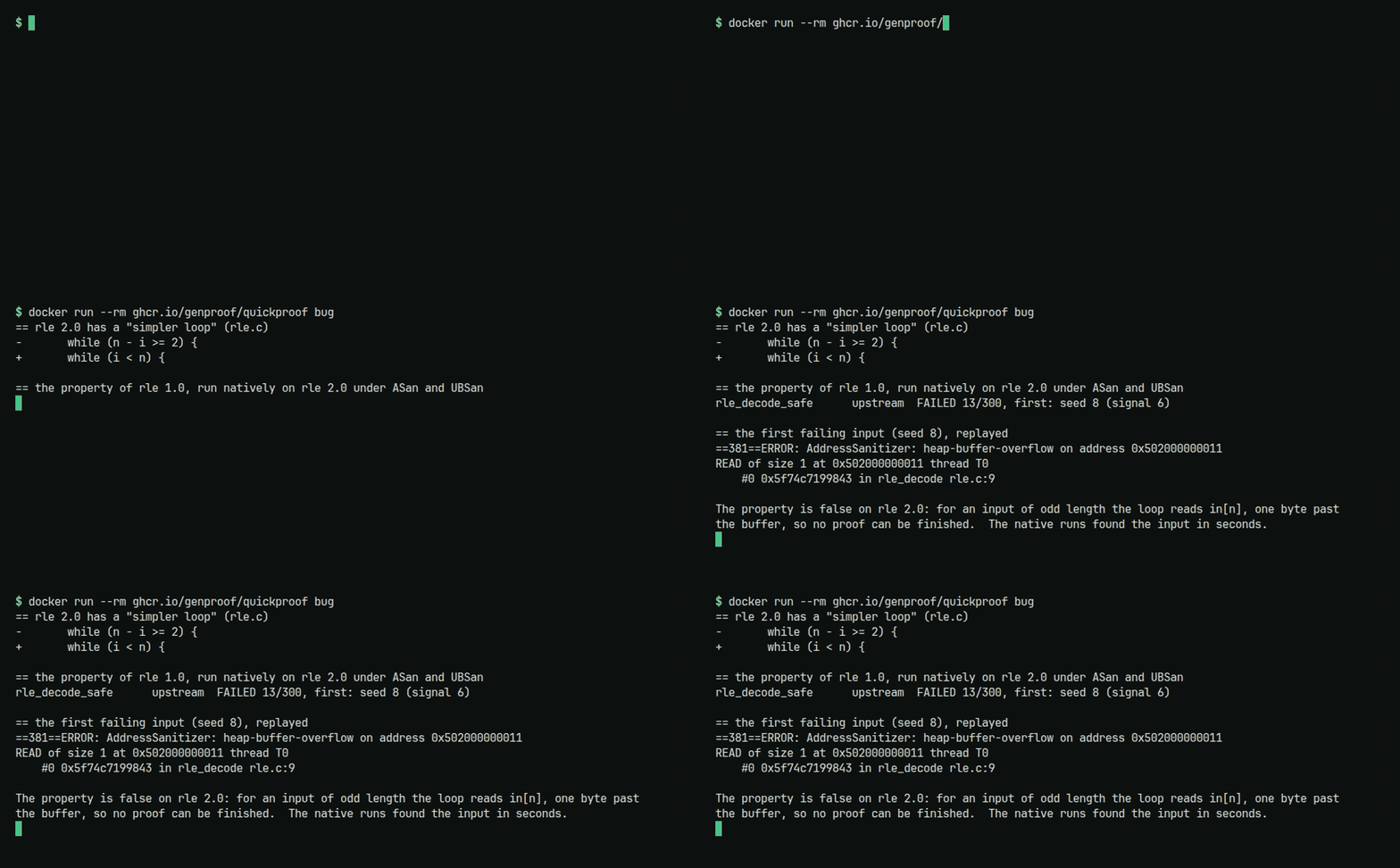
A false spec can still slip past the checks: a finite number of runs may simply miss the input that breaks it. Then the proof does not go through, and the agents come back with that input instead of a proof. When the code is at fault, we patch it, prove the same property on the fixed version and list the patch in the repository.
For the rle example, against a release of the decoder with a bug, the runs find an input of odd length within seconds that makes it write past its buffer. Some zlib specs were false on zlib 1.3.2 as released, and six of those nine bugs are now fixed upstream (the list). The WireGuard specs found that the Linux kernel’s lib/crypto handled lengths of 4 GiB and more wrongly. No caller in the kernel passes such lengths, and the proof is about the code with our two patches.
What you review, and what you trust
Two things deserve your attention: the specs written with QuickProof, and the changes made to the code for the proof. Everything else is checked by tools that time and many experts have tested: Rocq’s kernel checks the proof, VST is proved sound with respect to CompCert’s semantics of Clight, and qp verify compares QuickProof’s environment (the specifications of nondet_*, malloc and qp_assert) with the framework release. The translation of C into Clight by clightgen is one of the steps not proved here; we trust it as everyone who uses CompCert does.
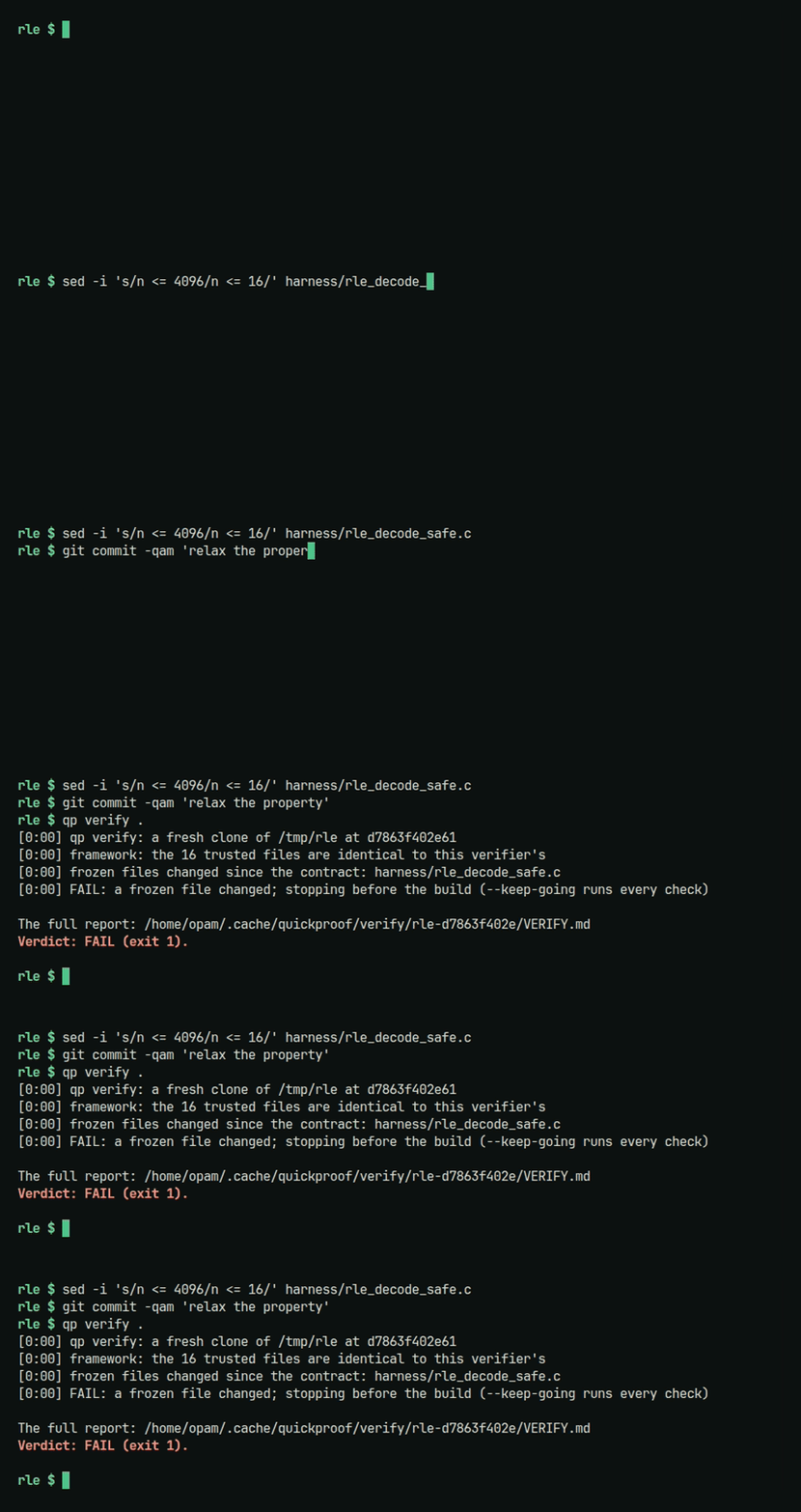
So reward hacking is not a concern: the only place it could happen is the statement of the properties and the changes to the code, and those are what a person reviews, with the standard theorem and the contract, which fixes everything before the proof starts.
For zlib 1.3.2 the specs are about 5,500 lines of C against about 590,000 lines of proof.
What a proof means
The theorem says that a QuickProof spec is correct for any values of the framework’s generator functions: run under CompCert’s semantics, it never reaches undefined behaviour (an access out of bounds, a use after free, a read of uninitialised memory, a signed overflow) and fails no qp_assert. What it does not state is, for example, anything about parallel runs. The final theorem says that every run is correct, with no undefined behaviour and no failed qp_assert, but not that a run terminates.
The theorem is about C as CompCert defines it for 64-bit x86 Linux (LP64), not about the binary that gcc or clang build. Compiler bugs and other platforms (on ARM, for instance, char is unsigned) are outside it. malloc and free are described abstractly, by VST’s library: the proof holds for any allocator that meets that specification. malloc may return NULL on any call, so the spec and the library must both handle it.
One more step: VST’s adequacy theorem, which turns our theorem into “no run has undefined behaviour”, is upcoming for QuickProof’s environment: it is not yet applied in Rocq here.
The proof itself often uses more general and stronger statements about the code. Rocq has checked those too, so they are true, but nobody has reviewed what they say. That is why only the final theorem about the spec counts as the claim.
The docs page What a proof means spells out the exact statement and what it relies on.
Quick start
The quickest way to see how it works is to check a proof that is already done. The Docker image contains the whole toolchain, QuickProof itself and its examples:
# check the proof of an example, in Docker (a minute or two)
docker run --rm ghcr.io/genproof/quickproof verify rle
In a minute or two you get the verdict PASS. Next, write your first property, or, without Docker, install everything with opam (Install) and follow the recipe. To prove your own code in Docker, see the Docker walkthrough.
What has been proved
Each proof lives in its own repository: every property is written there as a C spec, the upstream commit is pinned, and every change we made to the code is listed. One command, qp verify, checks any of them.
zlib 1.3.2, the core library
zlib
da607da7- What is proved
Ten properties a user of zlib relies on: compression and decompression are deterministic, decompression does not consume what follows the stream, a round trip gives back exactly the data, too little output space gives
Z_BUF_ERRORand the start of the data, the compressed size and the memory of both directions stay within stated bounds, and decompression is memory-safe on any input. The gz* file API andinfback.care not covered.- Specs
- 62
- Bugs found
- Bugs found
- Status
- Proved
WireGuard in Linux
Linux
551c722f- What is proved
Nineteen short specs: the handshake’s keys agree and its secrets are erased, stale, replayed and failed messages change nothing, the replay window accepts each nonce once, and the AEADs give back what they encrypted.
Nineteen longer specs from the first proof compare the kernel with a model of the handshake and the primitives with reference implementations; four of them rest on glue that is assumed or copied, not verified.
- Specs
- 38
- Bugs found
- The bug the specs found
- Status
- Proved
OpenSSL’s punycode decoder
OpenSSL 3.6.5
c8bd5a57- What is proved
crypto/punycode.c, the code of CVE-2022-3602 and CVE-2022-3786. Both functions accept any input and give only documented results, decoding follows RFC 3492, the reported sizes are exact, and OpenSSL decodes what an RFC 3492 encoder writes for any sequence of up to 3855 Unicode code points.- Specs
- 19
- Bugs found
- The bug the specs found
- Status
- Proved
zstd’s decoder
zstd
01b7154f- What is proved
Twenty-five short specs: on any bytes the decoder stays within its buffers, frames of Raw and RLE blocks decode to exactly their content, invalid and truncated frames are refused, and the memory held stays within zstd’s own estimates. Nineteen longer specs draw compliant frames, compressed blocks and dictionaries included, within stated bounds.
- Specs
- 44
- Bugs found
- Bugs found
- Status
- Proved